Spring Through All Your Senses: Get Your Inner Sap Flowing
Spring is a time when everything in nature begins to move again, and our bodies naturally respond. After winter, we look for lightness, energy, and a return to rhythm. Walking is more than just getting from place to place. It helps awaken inner processes, release tension, and bring your attention back to yourself. We share what happens in your body while walking and how to bring this simple movement into your daily life with the support of Calmory.
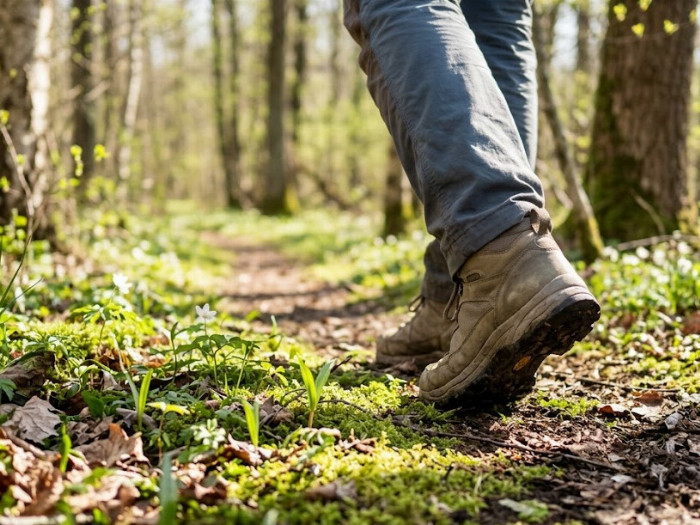
We experience spring through all our senses. The air smells of damp earth, the light is softer, and nature is beginning to move again. Trees draw up moisture so life-giving sap can rise to their crowns, and a similar process takes place within our bodies. After the winter months, which are naturally quieter and often less active, we need to get our circulation, lymphatic system, and nervous system moving again. The body responds naturally—it wants to go outside, take a deep breath, and take that first step.
Walking in this context is not just movement. It is a fundamental biological mechanism that helps the body return to balance. The rhythm of your steps creates a steady pulse that activates processes linked to recovery, oxygenation, and the gradual release of tension.
The Foot as a Gateway to the Body
Our feet are among the most sensitive parts of the body. They contain thousands of nerve endings that constantly gather information about the surface, stability, and movement. Each step is therefore not just a mechanical action, but also a signal to the brain on how the body should adapt.
Grounding contact plays an important role in regulating the nervous system. Studies focusing on movement in nature show that natural terrain and mindful steps help reduce stress responses and support a return to a calmer state. Sabina Nývltová, for instance, describes this principle in her work on the influence of natural environments on anxiety.
Reflexology brings another perspective. It suggests that specific areas of the feet correspond to different parts of the body. Rather than a rigid map to be studied, it offers a principle: through touch and gentle pressure on the feet, we can influence our overall bodily awareness and foster relaxation.
How Feet Influence the Body
Working with your feet can be very simple yet effective. It isn't a complex technique you need to spend hours learning; just a few minutes of mindful attention is enough.
Toes
Gently rub each toe between your fingers. Briefly press and release.
This area corresponds to the head and neck, helping to release tension carried from overthinking or prolonged focus.
Ball of the Foot
Try gently pressing the front part of your foot below the toes.
Move slowly, without forcing anything. This area is often associated with the chest and breath.
As you touch it, you may notice your breathing gradually slowing down.
Arch of the Foot
Glide your thumb along the center of your foot from heel to toe.
This section relates to digestion and is also a place where we often hold tension without realizing it.
Heel
Massage your heel a bit more firmly, or consciously lean onto it for a moment. The heel is associated with the pelvic region and bodily stability. It helps bring your focus back down and creates a feeling of being grounded.
A Small Ritual That Makes Sense
You don't need to spend much time on it.
A few minutes in the evening or after coming inside is enough.
Take off your shoes, pause for a moment, and offer some attention to your feet. The body responds surprisingly fast.
Not because we are "healing organs," but because we are returning to our body and our senses.
What Happens in the Body During Walking
Walking has a direct impact on the functioning of the nervous system. Rhythmic movement helps lower the activity of the amygdala, the part of the brain that detects threats and triggers the stress response. As a result, the body gradually shifts out of high alert into a state of greater calm.
At the same time, the vagus nerve—which plays a key role in stress regulation—is activated. Its engagement slows breathing, lowers heart rate, and brings an overall sense of relaxation. This process is supported by the rhythm of walking, which naturally synchronizes breath and movement.
The lymphatic system also plays a vital role. Unlike the circulatory system, it has no central pump and relies on muscle movement. Walking therefore helps clear metabolic waste from the body and supports recovery. As Martin Záhoř notes in his study on outdoor movement, regular physical activity in natural surroundings positively affects both physical and mental well-being.
When You Bring Awareness, Walking Changes
The key difference isn't just that we move, but how we move. Many people today walk quickly while their attention remains far away from their body—checking phones, watches, or lost in thought. While the body is moving, the nervous system remains stressed.
The moment we bring awareness to our walk, everything shifts. Simply notice small details: the ground beneath your feet, the cadence of your steps, surrounding sounds, or your breath. Without trying to change or judge anything. Just observing. In that moment, walking transforms from mere movement into a tool for self-regulation.
How to Bring This Into Your Daily Life
There is no need to walk long distances or overhaul your entire routine. Start with small steps.
A short stroll during the day, a few minutes of mindful walking on your way home from work, or simply pausing to feel your feet when you arrive home. Even these small moments truly matter.
In the Calmory app, you'll find guided techniques to support you through this process. They help connect breath, step, and awareness so that walking becomes more than an automatic habit—a mindful tool for working through stress and tension.
Sources:
Nývltová, S. (2025). The Effect of Natural Environments on Anxiety. Charles University.
Záhoř, M. (2024). The Impact of Physical Activities in Natural Environments on the Autonomic Nervous System. Charles University.
Disclaimer: This article is for informational purposes only and does not replace professional medical or psychotherapeutic care. If you are experiencing an acute crisis, please contact professionals or crisis helplines.

Calmory Author Team
We are a team of writers who believe in the power of stories and honest emotional sharing. We focus on topics related to mental health, personal growth, and everyday life as it is truly lived. We write with respect, openness, and humanity. Our texts come from personal experiences, from the heart, and from ordinary situations that we all go through.
Klid se dá naučit.
Začněte s Calmory ještě dnes.
Dostupné nyní pro iOS a Android

Naskenujte QR
a stáhněte si aplikaci