Senses as an emergency brake: Why your body understands touch better than words
We all know this feeling. We're sitting in an important meeting or trying to fall asleep when a wave of anxiety washes over us. Our rational mind tries to logically explain that "it's nothing," but the body doesn't listen. The heart pounds, palms sweat. This is because in crisis mode, our brain shuts down the logical center and switches to instincts. To calm down, we need to speak to the body in the language it understands at that moment: the language of senses, pressure, and rhythm. Calmness isn't a matter of willpower, but a biological skill that we can teach our body anew.

Why "thinking positively" doesn't work when you're anxious
When you experience stress, your sympathetic nervous system (fight-or-flight mode) activates, leading to what psychologist Daniel Goleman (author of the bestseller Emotional Intelligence) called "amygdala hijack." Blood literally drains from the part of the brain where logic and perspective reside, flowing to the muscles and the fear center. The amygdala is an almond-shaped cluster of cells that acts as your personal threat detector. As soon as it detects danger, it triggers an immediate reaction without conscious thought.
Trying to "think calmly" in a moment of stress is like asking a computer to calculate complex equations when its processor is on fire.
To "restart the brain," we need a physical intervention, not a logical argument. Sensory techniques like Grounding or Tapping utilize the principles of Dr. Stephen Porges' Polyvagal Theory. They bypass logical thinking and send a signal of safety directly to the brain. They tell the body: "I see, hear, and feel a reality where nothing bad is happening right now."
The magic of touch and boundaries: Where do I end and chaos begin?
In deep stress, we often experience a feeling of dissociation, as if we're floating outside our own bodies or "dissolving" into the world's problems. As Dr. Bessel van der Kolk (author of The Body Keeps the Score) confirms, stress disrupts our perception of physical boundaries, where we end and the environment begins. Pressure gestures (e.g., firmly pressing palms together or placing hands on thighs) act as a biological reminder of your boundaries. The physical resistance you feel under your hands sends a clear message to the brain: "I am here, and this is my safe space." It's like a firm hug you can give yourself when you feel like you're falling apart internally. It helps you feel "whole" again.
Temperature and scent: A direct line to the emotional center
Did you know that smell is our fastest sense? While the image of what you see requires the brain to "chew through" and evaluate it in a complex way, a scent (of coffee, lavender, or cinnamon) travels directly to the emotional center of your brain. It's like an express line that doesn't need any approval. That's why the smell of freshly cut grass, your favorite perfume, or coffee can transport you to a state of well-being in milliseconds.
Contact with a cold object works similarly. When you place something cold on your wrist or face, you activate the body's natural calming response. Sudden cold acts as an "off switch" for spiraling thoughts. A sudden cold stimulus on the skin activates the mammalian diving reflex, a shock of cold that forces the brain to completely stop worrying for a second and focus on that intense physical sensation on the skin. This creates exactly the crack in anxiety you need to be able to breathe again. It instantly slows your heart rate and diverts blood to vital organs. It's essentially a "biological off switch" for obsessive thoughts.
Rhythm: Returning to the certainty of childhood
Our bodies love rhythm. It's encoded in us from the very beginning, from the nine months we spent in our mother's womb listening to the steady beat of her heart. It's the most fundamental certainty we know. Techniques like gentle rocking or tapping awaken this old memory in our bodies.
Slow, regular movement sends a clear message to your body that everything is okay. Rhythm is the exact opposite of the chaos we feel during stress. When you start to gently rock from side to side, you activate the balance center in your inner ear, which has a direct connection to the part of the brain that controls fear. It's essentially a "biological lullaby" that you can give your adult, overloaded self so it can feel safe and calm again.
Imagination: The emergency kit in our head
You might think that "imagining something" is just an escape from reality. But science says something different. Your brain and body can't quite distinguish between what's actually happening and what you're vividly imagining. When you watch a thrilling movie, your heart races, even though you're sitting safely on the couch. We can use this to our advantage.
When you can't change the situation around you, like a demanding day at work, you can change what's happening inside your head. If you mentally evoke your "Safe Place" with all its details, feel the warmth of the sun on your skin, hear the rustling of the forest, or smell the sea air, your body will react immediately. The adrenal glands will stop pumping stress hormones, and your muscles will relax.
This technique isn't just "daydreaming." It's a strategic battery recharge. It's a place where your nervous system can escape for a few minutes to rest, so it can then tackle real problems with much greater clarity and perspective.
To make this journey to calm even easier, you can also involve your ears. Nature sounds, the sound of waves, or gentle relaxation music act as the perfect "background" to anchor your imagination in reality. That's precisely why we at Calmory have prepared a rich library of sounds to help you transport yourself to your inner sanctuary in seconds.
Calmness can be learned: Become the architect of your well-being
At Calmory, we believe you are not a victim of your stress. Your nervous system is neuroplastic, meaning it can change and strengthen at any age. Every practice of these techniques, every sip of water drunk with full attention, is a small training session for your "calm muscles." The more often you use these techniques, the faster your body will respond to them in the future.
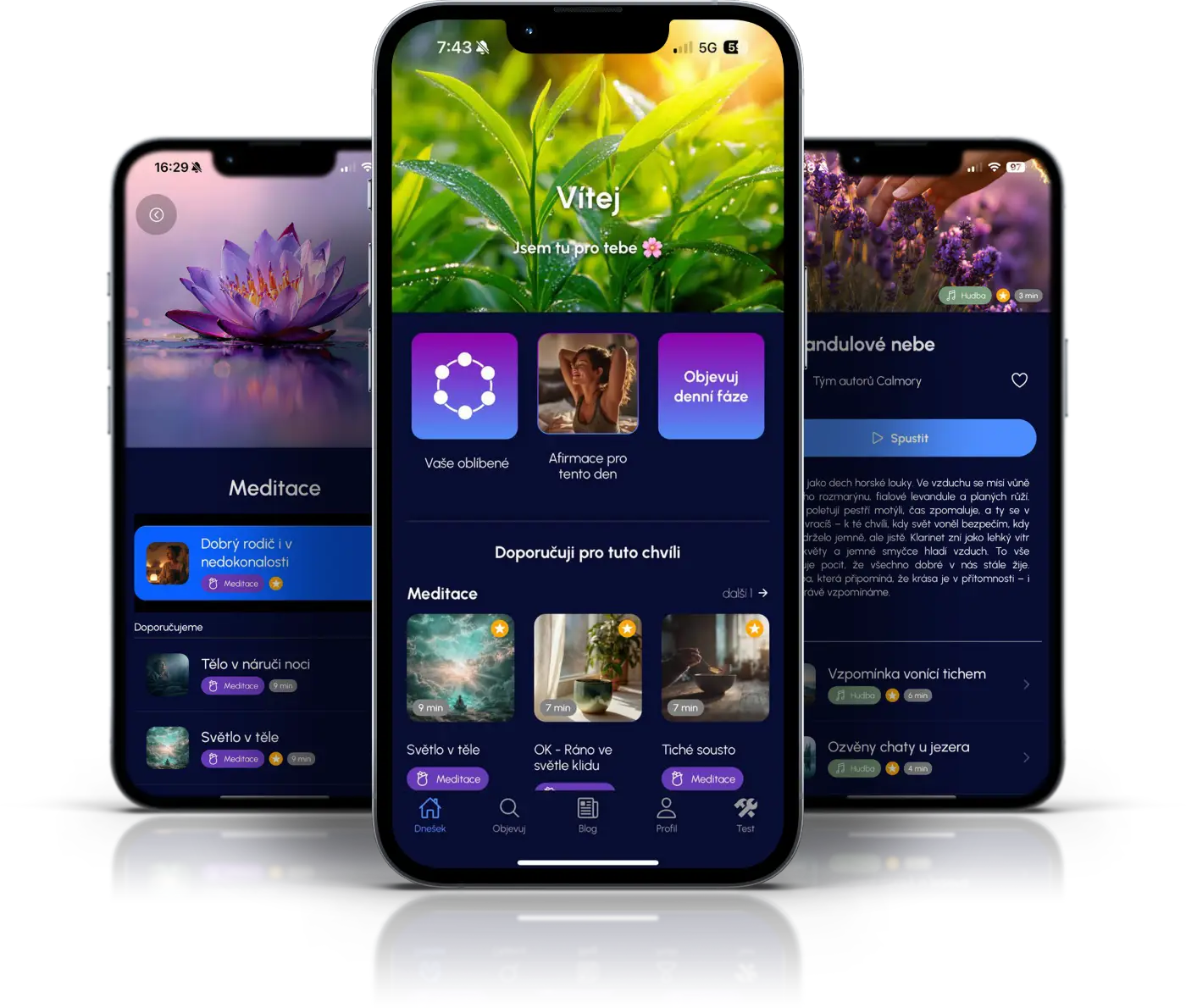
Calmness isn't a state you reach once and stay in. It's a skill that we practice together at Calmory. In the app, you'll find much more than just instructions. It's your safe space, which you just need to open whenever you feel overwhelmed. Calmness isn't the absence of problems; it's the ability to return to yourself even in the midst of a storm.
Your personal calm-down kit in the Calmory app:
- SOS Techniques (Immediate help for a "here and now" sense of safety):
5-4-3-2-1 Techniques or Pressure Gestures immediately bring your attention back from anxious thoughts to reality.
Through senses and gentle pressure, you give your body a clear message: "I am safe here and I know my boundaries."
- Sound Sanctuary (When you want to tune out the outside world): Sometimes words aren't enough. That's why at Calmory you'll find a rich library of relaxation music and nature sounds.
The sound of waves, crackling fire, or gentle rain in the forest are your auditory guides that will transport your mind to safety in seconds.
- Quick Restart (When you're overwhelmed):
If you need to "turn off" the stress response right now, reach for Contact with a Cold Object.
The shock of cold or Conscious water drinking activates the calming nervous system (vagus) within seconds.
- Self-care for every day: More techniques, motivational challenges, and our 30-day calm course await you in the app.
It's a path to teach your nervous system to respond to stress in a new way so you can enjoy your day and your entire life to the fullest.
Mission for today:
Open Calmory just for a "test run." Explore it and play some forest sounds for a moment, and notice how your body reacts. This will create a pathway in your brain that it can find on its own with complete certainty in a more challenging moment.
Calmness can be learned. And with Calmory in your pocket, you are never alone.

Calmory Author Team
We are a team of writers who believe in the power of stories and honest emotional sharing. We focus on topics related to mental health, personal growth, and everyday life as it is truly lived. We write with respect, openness, and humanity. Our texts come from personal experiences, from the heart, and from ordinary situations that we all go through.
Klid se dá naučit.
Začněte s Calmory ještě dnes.
Dostupné nyní pro iOS a Android

Naskenujte QR
a stáhněte si aplikaci