Why short moments of calm work better than a long holiday
Many people wait for calm to arrive with time off, a holiday, or a big change. But the nervous system does not work that way. The body does not remember exceptional moments — it remembers experiences that repeat. In this article, we look at why small moments of calm have more power than a one-off rest.
What the body actually remembers
You may look forward to a holiday for months.
And you may also know that feeling when, after you return, you feel more tired than before.
Calm arrived.
But it left again quickly.
And then the everyday pace comes back, the duties, and the feeling that “there is never time again”.
Why a holiday does not actually teach the body calm
A holiday is a change.
But it is often too big a change all at once.
For the body, it can be:
-
a sudden switch-off after a long stretch of overstrain
-
a change of rhythm, environment, and expectations
-
a short swing that cannot be sustained
The nervous system has no time to adapt.
It only rests for a while, then returns to what it knows best.
The body learns calm the same way it learns everything else
Just as we learn movement, speech, or new habits, the nervous system learns too, and it learns through repetition.
Not through exceptional experiences.
But through small, familiar situations that return.
That is why a minute of calm several times a day has a greater impact than a week of calm once a year.
The body remembers rhythm, not the calendar.
Small moments of calm as a signal of safety
A brief pause, a slow sip of water, a moment of silence, or a conscious breath are not trivial.
They are clear signals that it is not necessary to stay on alert all the time.
For the body, this means:
-
“I don’t have to deal with anything right now”
-
“I can ease off for a moment”
-
“I am all right where I am”
When these signals repeat, the nervous system begins to store them as a new experience.
Why regularity matters more than length
Long rest with no follow-through often cannot hold onto calm.
Short but regular moments can.
Because:
-
the body does not switch by jumping
-
calm needs continuity
-
small doses are safer than big changes
That is why, at Calmory, we focus on short techniques that can be woven into an ordinary day.
Not as another duty, but as part of the rhythm.
What calm can look like in an ordinary day
When we talk about short moments of calm, we do not mean anything exceptional.
It is not a new regime, and it is not another duty.
It is about small moments that can be woven directly into what we are already doing.
For example:
In the morning, before the day takes off
A slow, conscious sip of water can be the first pause of the day.
Not so that we “train” something, but so that we give the body a signal that it does not have to rush straight away.
During the day, between two tasks
A brief shift of attention to something concrete. The colours in the room, the sounds around you, or a simple task give the mind a pause and the body room to breathe out.
When the mind races too fast
A gentle mental anchor, such as counting or briefly pausing a thought, helps create distance from constant thinking.
Not so that the thoughts disappear, but so that they step back for a moment.
After a difficult conversation or stress
A conscious touch, gentle pressure of the palms, or a short breath practice helps the body close the tension instead of carrying it on.
In moments of tiredness
Listening to music, to sounds, or smelling a gentle scent can help the body find its bearings again, without us having to “restart”.
These small moments are not trivial.
They are what makes up what the body perceives as a safe rhythm of the day, and they are the building blocks of calm.
When calm becomes part of the day
Gradually, you may notice that:
-
returning from tension is easier
-
the body responds to slowing down more quickly
-
stressful situations do not have as much power
-
calm is not an exception, but a possibility
These are not coincidences.
This is a nervous system learning a new pattern.
What to take away
Calm is not something that arrives once and stays.
It is a skill the body takes in through small steps.
Short, repeated moments of calm have more power than a one-off rest.
Because those are the ones the body remembers.
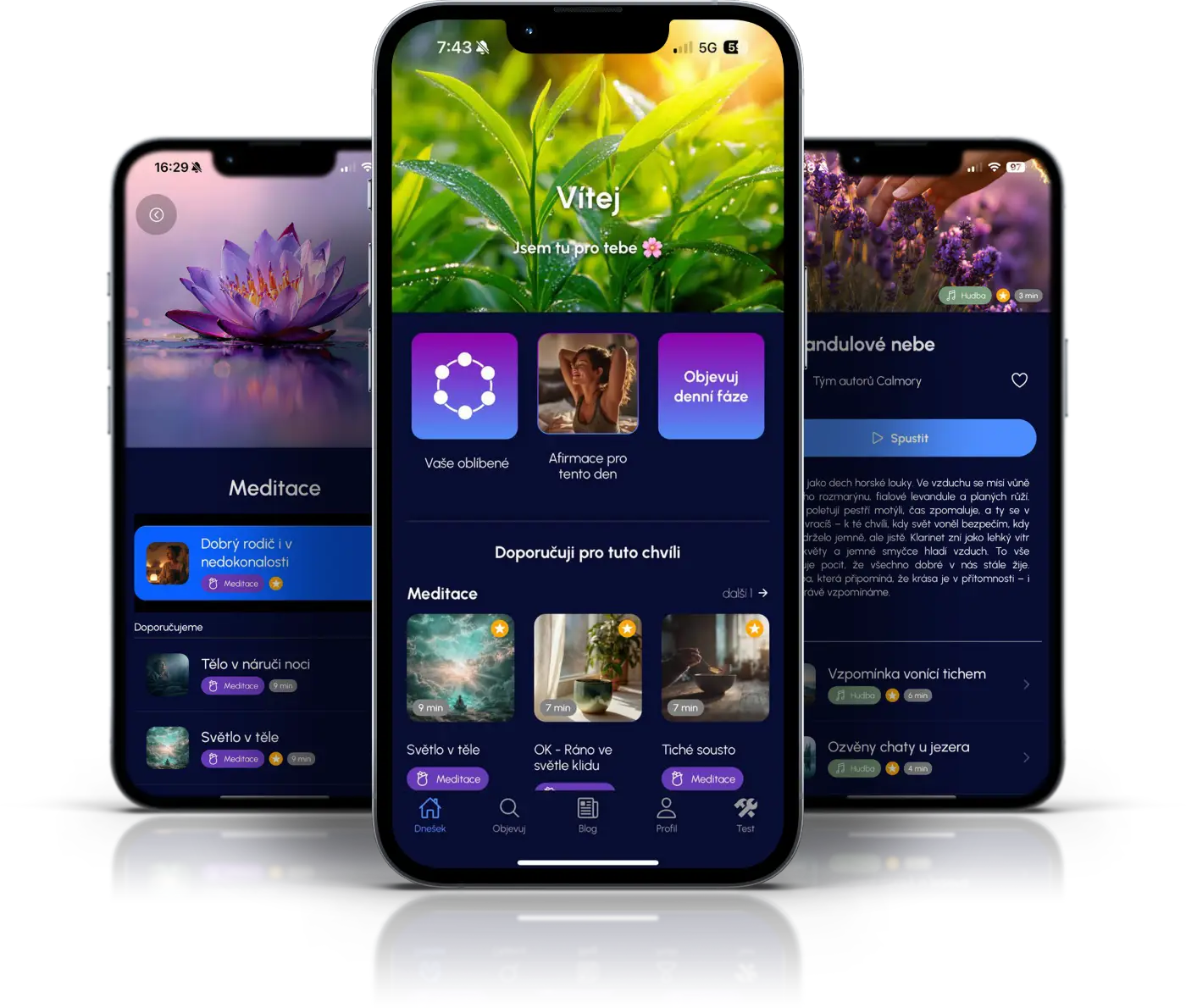
You will also find all these gentle paths to calm in the Calmory app.
Not as duties, but as an invitation.
In the app, we work with short techniques, small challenges, and simple tasks for redirecting attention, which can be woven directly into an ordinary day.
There are also relaxing meditations, breathing exercises, music, and nature sounds that help the body slow down and come back to itself.
The app guides you through each step with a guide’s voice and offers support in different phases of the day – morning, during the day, and in the evening.
So that calm is not something distant, but something you can return to again and again.
Because calm can be learned.
Step by step, gently, and in a rhythm you can manage.

Calmory Author Team
We are a team of writers who believe in the power of stories and honest emotional sharing. We focus on topics related to mental health, personal growth, and everyday life as it is truly lived. We write with respect, openness, and humanity. Our texts come from personal experiences, from the heart, and from ordinary situations that we all go through.
Klid se dá naučit.
Začněte s Calmory ještě dnes.
Dostupné nyní pro iOS a Android

Naskenujte QR
a stáhněte si aplikaci